After the fall from favour of Henry VIII’s final chief minister, Thomas Cromwell, in June 1540, the Privy Council became the most powerful ‘advisor’ for the final years of Henry’s reign, devolving influence at court across a select group rather than centring it in one dominant individual. In the seven years between Cromwell’s death and Henry’s, developments in the council’s organisation and administration offer important insights into power at the Tudor court. Despite this, the Privy Council has been fundamentally underserved in historical scholarship considering this period, with little critical investigation of the development of the institution in this time since surveys in the second half of the 20th Century, led by Geoffrey R. Elton and John Guy. Though work since has offered explorations of the early modern Privy Council, these focus primarily on the more defined Elizabethan Privy Council or include the council as part of a study on a single historical figure and their career. As such, there still remains little consensus on the development and establishment of the early Tudor council, and its role in governance. Building on key theories, methodologies, and quantitative measures developed in the field of network science and social network analysis, ‘A King’s Counsel: The Evolution of the Privy Council in the Reign of Henry VIII, 1530-1547,’ explores the development of this key early modern institution and its role as an influential and powerful entity at the court of Henry VIII.
The Privy Council of England
\
intro to Privy Council
\
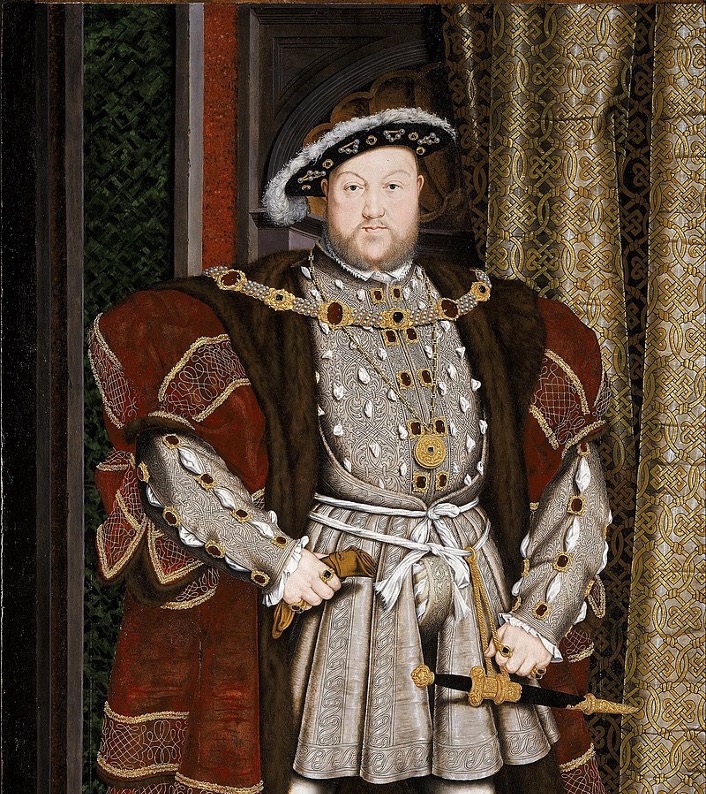
Henry VIII
Portrait of Henry VIII by Hans Holbein, the Younger. c. 1537. Oil on canvas, 239 by 134.5 cm. Walter Art Gallery, Liverpool, WAG 1350. Source of image: WikiCommons
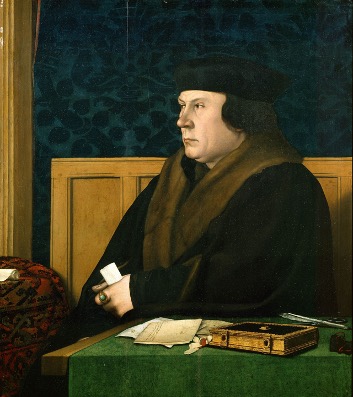
England, 1540-1547
Thomas Cromwell by Hans Holbein, the Younger. c. 1532-1533. Oil on panel, 78.1 by 64.1 cm. Frick Collection, New York, Henry Clay Frick Bequest. Source of image: WikiCommons.
The Registers
Transcriptions and Conventions
Italicised – extended contraction.
Strikethrough – where the text in the original has been crossed out.
Superscript – where the text has been placed above the original line of text as an addition and/or correction.
[In brackets] – my insertions, often where manuscript is damaged.
Technical Credits - CollectionBuilder
This digital collection is built with CollectionBuilder, an open source framework for creating digital collection and exhibit websites that is developed by faculty librarians at the University of Idaho Library following the Lib-Static methodology.
Using the CollectionBuilder-CSV template and the static website generator Jekyll, this project creates an engaging interface to explore driven by metadata.